I've been suffering from writer's block. I suppose its not unusual, after all, I'm still struggling to accept my father's death and work and its accompanying dramas seem to suck up all the time and energy I have. However, here's a short run-down of all the things I'd like to write about or post but haven't had the energy to do yet.
My trip to Tuscany and the fabulous food
My trip to Normandy with my sister to visit the D Day sites - very thought provoking, particularly since I then went on a course on International Humanitarian Law in Brussels immediately after.
The use of anthropologists in Human Terrain Teams in Afghanistan
The encroaching winter time - it's 7am and the sun isn't up yet. I'm not sure if I'm prepared for this!
The rest of the photos from my trip to the midwest. Espescially the Corn Palace in South Dakota and my speeding ticket in Nebraska.
My love for pre-WWII espionage novels
Anyway, I'll try to carve out some time and inspiration.
Thursday, September 24, 2009


Thursday, August 27, 2009
Still bewildered in Holland
Even though I've been here two years and four months, I still find things that bewilder me from time to time. Tonight I went shopping for sheets and new pillows because my sister is coming to visit and she's a pillow snob. I went to the Bijenkorf because its a swanky department store and I was feeling flush with cash and wanting to splurge on some high thread count sheets.
When I go there, I realized they don't have single, double, queen, california king and king... they have 90 cm, 200 cm, 220 cm lengths and different widths! I have no idea what length and width my double bed is. I tried to describe it by saying things like "It's for two people and its longer than normal." Hmmm. Then I bought some pillows. They are square - not rectangular. The bed set that I bought has a duvet cover and two pillow cases but no fitted sheets.
It's really humbling to be an idiot asking silly questions as an adult. But on a brighter side - I'm so Dutch acclimatized, I rode home with two duvet sets, two giant pillows, a box of wine glasses, my purse and extra raincoat all packed on my bicycle without a single accident. I didn't risk listening to my iPod during the time but I did think about it.
When I go there, I realized they don't have single, double, queen, california king and king... they have 90 cm, 200 cm, 220 cm lengths and different widths! I have no idea what length and width my double bed is. I tried to describe it by saying things like "It's for two people and its longer than normal." Hmmm. Then I bought some pillows. They are square - not rectangular. The bed set that I bought has a duvet cover and two pillow cases but no fitted sheets.
It's really humbling to be an idiot asking silly questions as an adult. But on a brighter side - I'm so Dutch acclimatized, I rode home with two duvet sets, two giant pillows, a box of wine glasses, my purse and extra raincoat all packed on my bicycle without a single accident. I didn't risk listening to my iPod during the time but I did think about it.
Tuesday, August 18, 2009

Friday, July 31, 2009
Gay Pride Parade
Saturday, August 1 will be the Gay Pride Canal Parade in Amsterdam. My friend Alec will be joining me from the US and we'll go and watch 10 Dutch American couples be married by the Mayor of Amsterdam. There's tons of events going on. The Yoga for men logo caught my eye so I thought I would share it with you all. Enjoy!


Tuesday, July 21, 2009
Ted Gose

I was devastated to hear that a very dear friend, no family member, died this weekend. Some of you may remember Ted Gose, the man who donated his house to host my father's funeral luncheon. He died this weekend. My heart goes out to his 16 year old son, Art, who I've known his entire life and his wife, Barb, and his daughters and step-son.
Ted (or Teddy Bear as my father and mother liked to call him) was a wonderful man. Warm, funny, smart, and endearing. He had the biggest heart in the world. My parents lived across the street from him for almost 20 years and thought of him as the son they never had. The photo above is from a dinner we had at Angel's - a mexican restaurant in Sumter that my father loved. Ted arranged for them to donate food for my father's funeral. Ted and Barb always dropped by and took my dad out or checked in on him to see how he was doing. He was there to give me advice when I needed it and to help out whenever we asked.
I loved Ted very dearly. I will miss him. My heart breaks. Its just too much. The world will be a much sadder and lonelier place without him.
Monday, July 20, 2009
Road Trip 2009: Of South Dakota and Corn Palaces

Neither Alyson nor I had ever been to South Dakota or Nebraska. We had gone to Iowa as young girls with my father, I had been to Minnesota for a wedding after college. Since we were flying into Omaha, we thought we couldn't miss the opportunity to see South Dakota too. Unfortunately, we were trying to conserve Alyson's vacation time so we missed the cousins big trip to the Badlands and didn't have time to stop at Laura Ingalls Wilder's homestead spot that was about 2 hours off the highway but I have a feeling that we'll try to return to South Dakota. Home of Tom Brokaw, Cheryl Ladd, and Tom Daschle!


Sunday, July 19, 2009
Road Trip 2009: Surprisingly beautiful Nebraska
My only real interaction with Nebraska in the past has been awe at the power of the 80s Cornhusker football team, reading "My Antonia" and Little House on the prairie books, and my friend Linda who was from there. I had a vague image in my mind of long flat boring countryside. Boy was I wrong, I found Nebraska beautiful. I would even go back although I'm still smarting from my speeding ticket from Norfolk, Nebraska. At least the police officer was polite! And talk about good service, the folks at the rental car agency were about the nicest people I've ever met in my life!
Enjoy some photos from my road trip with Alyson.


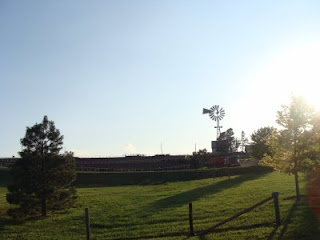
Enjoy some photos from my road trip with Alyson.


4th of July in George Iowa, part 2: The Pie Auction
The Pie Auction
What could be more small town and quaint than a pie auction? I had visions of the Andy Griffith Show in my head. Some dear old Aunt Bee laboring over her peach pie but being beat out by the hot new spinster teacher in town so the men banding together to purchase Auntie Bee's pie for an inflated price. I had big plans to purchase a rhubarb pie in honor of my Dad who loved rhubarb pie above everything. It was going to be one of the highlights of the 4th of July weekend in the Midwest.
The George, Iowa pie auction was held behind the elementary school by the baseball field right after a musical performance and before the fireworks. There was a small amusement park set up in the parking lot with a ring toss and bingo. You could buy ice cream and popcorn at the concessions stand. I arrived with my sister and my cousin Catherine prepared to bid for a pie.
Imagine my shock and horror to learn that the opening bid for these 109 home made pies was $100! The first pie went for almost $300!!!! This was no small town Southern sleepy pie auction. These Iowa farmers were rich! They auctioned 109 pies with the cheapest one going for $125. And they auctioned them like a true hog auction complete with fast talking auctioneer, spotters, and a loudspeaker placed somewhere over my head. It went on for at least an hour and a half. I couldn't even get in on the action for what sounded like a gross pie - sour cream and raisin. That one still was out of my range at $125.
I realized I had been laboring under a misconception of what small towns were like. Being rural and being a farmer does not necessarily mean being poor, I have learned. Years of living in the south and being subjected to "we're going to lose the family farm" movies form Hollywood lead me to believe that in the midst of the economic crisis that was to be rivaling the Great Depression that a small town pie auction to support the school would be an affordable deal. I know that George, Iowa suffered greatly during the last Great Depression. Signs in the museum spoke about "one of the many single men who drifted into town searching for work" and my father spoke about times being lean. But with the age of government subsidies for farms and a heavy reliance on genetically modified seeds, modern technology, and intense fertilizer - the Iowa farm looks mighty prosperous compared to the meager efforts I've seen in South America, Africa, and Asia.
So while in many ways, the 4th of July celebrations in Iowa were as stereotypical and patriotic and fun as I had expected, I learned an important lesson thanks to the pie auction. I think I may now be opposed to farming subsidies for US farmers.
UPDATE:
I suppose I was struck deaf by the garbled loudspeaker next to my ears at the pie auction. My cousin Linda has informed me that the video shows the pie being auctioned at $50. It was hard to keep track as 109 pies were auctioned and I was just anxiously awaiting the fireworks. But the first pie and several others did go for $300. Most of the purchasers were local businesses.
For those who feel that I maligned the good people of George, Iowa by saying how surprised I was that the town was prosperous, I apologize. I very much enjoyed my visit to George and found very pleasant people there. I was surprised at the wealth in a town of about 1000 people but I invite you to compare and contrast it to the farm towns that I've visited in South Carolina where grinding poverty is a visible way of life. The recession has hit my hometowns of Columbia and Sumter, SC hard and the effect is visible with for sale signs and foreclosure signs all over town and the line around the Salvation Army stretched around the block.
As for not supporting farm subsidies - I also invite me to send me info to educate me to your point of view. While the analogy of the pie auction and the wealth of the US farmer may be a clumsy one, I'm still not sure that farm subsidies are the way to go. Feel free to post links in the comments section.
What could be more small town and quaint than a pie auction? I had visions of the Andy Griffith Show in my head. Some dear old Aunt Bee laboring over her peach pie but being beat out by the hot new spinster teacher in town so the men banding together to purchase Auntie Bee's pie for an inflated price. I had big plans to purchase a rhubarb pie in honor of my Dad who loved rhubarb pie above everything. It was going to be one of the highlights of the 4th of July weekend in the Midwest.
The George, Iowa pie auction was held behind the elementary school by the baseball field right after a musical performance and before the fireworks. There was a small amusement park set up in the parking lot with a ring toss and bingo. You could buy ice cream and popcorn at the concessions stand. I arrived with my sister and my cousin Catherine prepared to bid for a pie.
Imagine my shock and horror to learn that the opening bid for these 109 home made pies was $100! The first pie went for almost $300!!!! This was no small town Southern sleepy pie auction. These Iowa farmers were rich! They auctioned 109 pies with the cheapest one going for $125. And they auctioned them like a true hog auction complete with fast talking auctioneer, spotters, and a loudspeaker placed somewhere over my head. It went on for at least an hour and a half. I couldn't even get in on the action for what sounded like a gross pie - sour cream and raisin. That one still was out of my range at $125.
I realized I had been laboring under a misconception of what small towns were like. Being rural and being a farmer does not necessarily mean being poor, I have learned. Years of living in the south and being subjected to "we're going to lose the family farm" movies form Hollywood lead me to believe that in the midst of the economic crisis that was to be rivaling the Great Depression that a small town pie auction to support the school would be an affordable deal. I know that George, Iowa suffered greatly during the last Great Depression. Signs in the museum spoke about "one of the many single men who drifted into town searching for work" and my father spoke about times being lean. But with the age of government subsidies for farms and a heavy reliance on genetically modified seeds, modern technology, and intense fertilizer - the Iowa farm looks mighty prosperous compared to the meager efforts I've seen in South America, Africa, and Asia.
So while in many ways, the 4th of July celebrations in Iowa were as stereotypical and patriotic and fun as I had expected, I learned an important lesson thanks to the pie auction. I think I may now be opposed to farming subsidies for US farmers.
UPDATE:
I suppose I was struck deaf by the garbled loudspeaker next to my ears at the pie auction. My cousin Linda has informed me that the video shows the pie being auctioned at $50. It was hard to keep track as 109 pies were auctioned and I was just anxiously awaiting the fireworks. But the first pie and several others did go for $300. Most of the purchasers were local businesses.
For those who feel that I maligned the good people of George, Iowa by saying how surprised I was that the town was prosperous, I apologize. I very much enjoyed my visit to George and found very pleasant people there. I was surprised at the wealth in a town of about 1000 people but I invite you to compare and contrast it to the farm towns that I've visited in South Carolina where grinding poverty is a visible way of life. The recession has hit my hometowns of Columbia and Sumter, SC hard and the effect is visible with for sale signs and foreclosure signs all over town and the line around the Salvation Army stretched around the block.
As for not supporting farm subsidies - I also invite me to send me info to educate me to your point of view. While the analogy of the pie auction and the wealth of the US farmer may be a clumsy one, I'm still not sure that farm subsidies are the way to go. Feel free to post links in the comments section.
Saturday, July 18, 2009
4th of July in George, Iowa, part 1: The Parade
In honor of my father, my sister and I went to George Iowa for the 125th anniversary of the town, my father's hometown and birthplace. I"m going to post a series of videos, photos, and remembrances of that weekend.
The Fourth of July Parade:
You can't have a fourth of July parade without men in funny hats driving souped up little cars. This is one of the best examples I've seen.
The Fourth of July Parade:
You can't have a fourth of July parade without men in funny hats driving souped up little cars. This is one of the best examples I've seen.
Thursday, June 25, 2009
Vacation - all I ever wanted!

"Vacation, all I ever wanted! Vacation - had to get away!" The Go-Gos
So its the first official day of my much anticipated vacation. When I planned it, I was in the midst of manic whirl of work, emotional turmoil, and lack of sleep. So it is a bit jam packed with activities and not necessarily all that restful but still - vacation!
I flew from Amsterdam to New York City yesterday - seasoned traveler that I am, I think its indicative of my mental state and the chaos I've been living in that I somehow got lost on the way to the airport. I go to Schiphol about once a month, at least, and I somehow managed to get lost. Granted, I shared a bottle of Prosecco, a bottle of sauvignon blanc, and some port with friends at a sunlit cafe in Amsterdam the night before so I was a little hungover but to get lost!? I blame it on my friend Jennifer who gave me a shortcut through the Amsterdam Zuid station to Schiphol from my house. Of course, it wasn't her that misdirected me, instead it was my hungover brain that made me misremember that and head to the Amstel station instead. I had to backtrack and that made me lose thirty minutes as I hemmed and hawed over whether to take the metro or a train. Then I missed the train to the airport and hadto wait another 20 minutes but hopped onto the wrong one. I caught my mistake and finally made it to the airport with only 45 minutes before departure. Luckily, I have an "elite status" with KLM so can check in with business class and cut the cue. Some seasoned traveler I am!
After an uneventful flight where I watched "the Watchmen" and "He's Just Not that Into you" along with a bloody Mary at the recommendation of my friend Mireille, I slept a bit and began to unwind a little. I zipped through immigration and customs at JFK arriving outside the airport about 30 minutes after I landed. Then I decided to brave the New York subway system to get to Harlem, where I'm staying with friends. After an uneventful ride, I arrived at Alka's house to a cold beer, good food, catching up and gossip. Slowly, the tension is starting to melt away.
So what's my crazy agenda like? Friday and Saturday - wedding festivities for Brian and Kevin in Brooklyn. I anticipate dancing like mad and laughing hysterically with my date and best friend, Alec. Sunday after a sumptuous brunch, we intend to drive back to DC where I'll stay catching up with old friends until Thursday.
Thursday morning, I fly to Omaha, Nebraska where I meet my sister and we rent a car and drive to George, Iowa.
for a family reunion. It's the 125th anniversary of my father's hometown and Alyson and I are trekking out there to honor him.
After 4th of July fun including: a street dance, duck race, tractor pull, and pie auction. Americana!!! I have made a special iPod mix to get me prepared for my immersion into my roots and to entertain my sister who is feeling a bit cynical about it all. She remembers our trip to Iowa as being filled with pig farms, corn, and 18 wheelers. I don't see why that is a problem but to cheer her up, we plan a side trip to the Corn Palace in South Dakota when we drive back to Omaha (even though its a bit out of the way). We are accepting other road trip destinations as well. Giant balls of twine?
On Monday morning, I return to DC and hop on a train to Chester Country, Pennsylvania where my good friends Rick and Cat will wine and dine me as we sit on their porch, drink great beer, grill out, perhaps walk around and look at the cows in their rural community, and reminisce. Their kids are gone to grandmas that week which means I'll miss them but it also means the adults don't have to be responsible and not stay up too late drinking for fear of children bouncing on beds in the morning!
On Wednesday, I return to JFK where I fly to Paris.
In Paris, I pick up a rental car and drive to Honfleur in Normandie where I will meet up with my old friend William and his fiancee. We'll spend a few days there drinking calvados, norman cuisine, touring the countryside and fattening up and then I take the train back to Amsterdam.
A bit whirlwind but sure to be fun as it encompasses some of the things I love the most: my family, my friends, road trips, and good cuisine.
Thursday, May 28, 2009
Remembering what's important
It's Thursday night on a beautiful sunny summer evening in Amsterdam. My neighbors are outside barbecuing and I can hear them from my bedroom window. I'm listening to Django Reinhardt and trying on dresses. I just got my hair cut. I'm making peace with my life - trying to obey my horoscope and see the beauty everywhere. Enjoying the sun on my face as I cycle home. Ignoring the scar from my fall in Colombia on my knee as I try on neglected sandals and high heels from DC. When I open my email to find a note from my sister in South Carolina. She's got old letters and my mother's old diary which I gave her after I found it in my mother's bedside table. My sister scanned in a letter that she found that I wrote to my mother when I was so young offering to start doing the cooking and washing around the house if I could start washing my own hair.
Suddenly all the ridiculous self imposed stress from work and the petty dramas which make up my every day life seem so small and far away. And I miss my family. I miss those who knew me when I was 8 years old and thought cooking with my mother was the coolest thing in the world. Hanging out with my dad when he walked down the street to pick up the Sunday papers. Riding bikes with my sister around the neighborhood and putting the cat into ridiculous costumes.
Sometimes I love my life - so "glamorous" living in Amsterdam, hanging out with fabulous and beautiful women, drinking wine in the park, and traveling to dangerous lands to try to help people. But right now I would trade it all just to come home again to 2 Warren Court, Sumter South Carolina and eat my dad's potato salad and catch up on the gossip of the court with him and just be home. Home Home Home. Where I often felt 14 years old and ridiculous but always loved and accepted.
Suddenly all the ridiculous self imposed stress from work and the petty dramas which make up my every day life seem so small and far away. And I miss my family. I miss those who knew me when I was 8 years old and thought cooking with my mother was the coolest thing in the world. Hanging out with my dad when he walked down the street to pick up the Sunday papers. Riding bikes with my sister around the neighborhood and putting the cat into ridiculous costumes.
Sometimes I love my life - so "glamorous" living in Amsterdam, hanging out with fabulous and beautiful women, drinking wine in the park, and traveling to dangerous lands to try to help people. But right now I would trade it all just to come home again to 2 Warren Court, Sumter South Carolina and eat my dad's potato salad and catch up on the gossip of the court with him and just be home. Home Home Home. Where I often felt 14 years old and ridiculous but always loved and accepted.
Tuesday, May 26, 2009
Thunder and Lightening
There was an amazing thunderstorm in Amsterdam last night. The whole sky was lit up with lightening and the thunder made my house shake and the cat hide under the covers. It was truly impressive in its force. It makes one aware of our tenuous position on this flat little spit of land that reaches out into the sea.
I love thunderstorms - especially heat lightening on a hot hot summer night in South Carolina. But this one kept me up for hours and I couldn't get to sleep. My mind kept racing around the different worries that I have and rather than being comforted by the overwhelming power of the storm and my reminder of how insignificant I am in the face of nature, I instead was plagued with incredibly realistic dreams about my worries.
I love thunderstorms - especially heat lightening on a hot hot summer night in South Carolina. But this one kept me up for hours and I couldn't get to sleep. My mind kept racing around the different worries that I have and rather than being comforted by the overwhelming power of the storm and my reminder of how insignificant I am in the face of nature, I instead was plagued with incredibly realistic dreams about my worries.
Friday, May 08, 2009
Getting through the Day pt 1
"What matters in life is not what happens to you but what you remember and how you remember it."
— Gabriel García Márquez
— Gabriel García Márquez
Sunday, April 19, 2009
Saturday, April 11, 2009
In Memory

Easter often coincides with the anniversary of my mother's death - April 11, 1997. I was in graduate school in George Washington University in Washington DC just finishing my comprehensive exams. My mother had been struggling with ovarian cancer for about 2 years and had taken a turn for the worse but my father had hidden it from me so I could focus on school. All I remember from that frantic flight home to see her before she died was how beautiful the weather was. April 11 often coincides with the most beautiful part of the South Carolina spring at my childhood home in Sumter. The azaleas are a riot of coral, purple, hot pink, and red with some white blossoms tucked in for contrast. The tulips that I bought long ago in Amsterdam are bobbing in the breeze and the dogwood trees and wisteria are in an ecstasy of bloom. Even my father's prized lilac bushes that were specifically bred to survive the hot Southern summer produce fragrant purple flowers.

Last year I was in South Carolina nursing my father back to health after he had surgery for a broken arm. We spent the day quietly at the hospital, reflecting on how much we missed her but not talking too much. We're not a family that talks about our emotions freely. I took photos of the garden in Sumter realizing somehow that I wouldn't spend another Easter there.
This year, I had hoped to go to England to visit my mother and grandmother's grave. My mother was cremated and my father had half of her ashes placed in the grave of her mother and half kept in a marble box in South Carolina for the inevitable time when he would die and they would be comingled. We traveled to Stratton Saint Margaret, the village where my mother grew up in Wiltshire (now a part of Greater Swindon) and had a small ceremony there for her with her family who were unable to come to the funeral in South Carolina. 1998 was the last time I saw my Uncle Roy, my Aunt Pearl, and my cousins Francis and Rob.
I just couldn't get it together. I returned home from Colombia on April 8 and had to try to get the ticket and everything sorted by the 10th and my jet lag, unorganized finances, and the complex Dutch and UK train systems on line defeated me. So I stayed home this weekend. It was lovely in Amsterdam today. The weather was warm and balmy. The tree leaves are starting to bloom. The daffodils are out. My friend Naomi gave me a bouquet of daffodils (the favorite flowers of both my mother and I) which I placed in my favorite blue pitcher that my mother and father brought back from a vacation in Italy before Alyson and I were born. I went to the butcher shop and bought a lamb shoulder and to the market where I bought some peas and some mint. I have rosemary growing on my balcony.
I'll honor my mother's memory by cooking today. She taught me how to cook when I was about 10 years old. She was a great cook even though she didn't enjoy it like my father and I do. In previous years, I've always tried to cook something special on the anniversary of her death so as to be bonded in memory of all those Christmases and Thanksgivings and Easters cooking in our kitchen in Sumter with my mother (and then my father). Although I am not in her kitchen today, the skills that she taught me (it's all in the timing! hunger is the best sauce!) will stay with me. I'll always be with her when I cook.
Thursday, April 02, 2009
The Guerrilla disease
I haven’t worked in Latin America (proper) since 1997 when I worked with Witness for Peace and NCOORD looking at issues in Nicaragua and Guatemala and this trip to Colombia marks my return to the context. In 1999 I lived in Guatemala for a little while mostly to study Spanish (and drink beer, and dance meringue, and go to movies with my friend Jamie). I always wanted to return to work here but there are so many capable locals who can do the work that they don’t really need many folks from the US to come down. On top of that, the US has played such an active role in many of the conflicts (overthrowing the Chilean government, supporting the Argentine dictators, overthrowing the Guatemalan socialist leader, Arbenz on behalf of the United Fruit Company, waging war in Panama, Nicaragua and El Salvador, and our continuous attempts to over throw Castro in Cuba) that American do-gooders aren’t that welcome. In particular, Colombia has “suffered” from particular attention by the US government. Our insatiable appetite for cocaine has made the route from the coca fields from Coca right up the Central American peninsula quite dangerous. There’s money to be made there and the overlap between political battles between the government of Colombia waging a war against terror against left wing guerrillas with the aid of “paramilitary” groups combined with the money to be made in a land grab to run cocaine, grow bananas, pineapples, avocados, coffee, and tobacco has made life hard for the peasants (indigenous people, people of African descent, and mixed “mestiza” population) who work the land and try to scratch out a living. The US government spends a lot of money arming the government of Colombia to “fight narco-traffickers and terrorists” with little to show for the 1.7 million USD dollars per day that the US Government gives to the army but the longest running civil war in the world and the most internally displaced people in the world (an IDP is a “refugee” who has not crossed an internationally recognized border).
In fact the US influence here is so strong that I’m supposed to pretend I am Dutch or any other nationality besides American. I’m an attractive target for political guerrillas to trade with the Colombia government and I can put the teams here in danger because the patients will fear that I’m a spy from the government and the paramilitaries. While my experience in Lebanon with Hezbollah taught me that its better not to lie as they usually know already what nationality you are, I’ve resolved to say “I live in Amsterdam, the Netheralnds” and “I flew here from Holland” – all of which is true. It’s hard though because my Spanish isn’t great nd we’re not supposed to speak English in front of strangers including in bars or restaurants or in the clinic in front of patients. I mostly stand around listening eagerly and hoping to catch a few words. My dormant Spanish has made a creaky comeback and I can chat to an extent as long as the other person doesn’t speak too quickly. My vocabulary is good by my grammar sucks. I mostly limit myself to banal observations about how hot it is or how delicous the frijoles I'm eating are.
After 10 years of focusing primarily on Africa with some focus on Haiti, Nepal, and Sri Lanka – I’ve finally made it back to South America. I’m learning a lot here. Many of the issues that plague the people of Latin America also plague the people of Africa, Asia, Eastern Europe, and the poor in North America… in particular, the disease of the poor are the ones that have the most restrictions on how you can treat them. One that I found particularly interesting is Leishmaniasis also known as Kala Azar. It appears to be a larvae from a but that when you are bit, injects parasites into your blood and you have wounds that won’t heal on your legs and arms and you can get parasites in your spleen, liver, and bone marrow. The bugs that carry this disease in Colombia live in rotted wood. In Colombia, we mostly treat women and children with this disease because they are the ones who are gathering wood or water and going out into the jungle the most. However, in many of the mountainous areas of Colombia, there are also a high number of Leishmaniasis cases.
The disease is very stigmatized and known as the Guerrilla disease. Therefore the government requires mandatory reporting of anyone who has this disease (violating their right to privacy) and strictly controls access to the medicine used to treat it. As we see mostly women and children, we are trying to lobby the government to drop this stigmatizing treatment of these patients and let us treat them so they can go on with their lives. While I have seen access to healthcare controlled for certain ethnic populations (poorly staffed and run health clinics for the Acholi in Uganda or the Ogadenis in Ethiopia), this is one of the first times I’ve encountered a disease linked to political issues.
In fact the US influence here is so strong that I’m supposed to pretend I am Dutch or any other nationality besides American. I’m an attractive target for political guerrillas to trade with the Colombia government and I can put the teams here in danger because the patients will fear that I’m a spy from the government and the paramilitaries. While my experience in Lebanon with Hezbollah taught me that its better not to lie as they usually know already what nationality you are, I’ve resolved to say “I live in Amsterdam, the Netheralnds” and “I flew here from Holland” – all of which is true. It’s hard though because my Spanish isn’t great nd we’re not supposed to speak English in front of strangers including in bars or restaurants or in the clinic in front of patients. I mostly stand around listening eagerly and hoping to catch a few words. My dormant Spanish has made a creaky comeback and I can chat to an extent as long as the other person doesn’t speak too quickly. My vocabulary is good by my grammar sucks. I mostly limit myself to banal observations about how hot it is or how delicous the frijoles I'm eating are.
After 10 years of focusing primarily on Africa with some focus on Haiti, Nepal, and Sri Lanka – I’ve finally made it back to South America. I’m learning a lot here. Many of the issues that plague the people of Latin America also plague the people of Africa, Asia, Eastern Europe, and the poor in North America… in particular, the disease of the poor are the ones that have the most restrictions on how you can treat them. One that I found particularly interesting is Leishmaniasis also known as Kala Azar. It appears to be a larvae from a but that when you are bit, injects parasites into your blood and you have wounds that won’t heal on your legs and arms and you can get parasites in your spleen, liver, and bone marrow. The bugs that carry this disease in Colombia live in rotted wood. In Colombia, we mostly treat women and children with this disease because they are the ones who are gathering wood or water and going out into the jungle the most. However, in many of the mountainous areas of Colombia, there are also a high number of Leishmaniasis cases.
The disease is very stigmatized and known as the Guerrilla disease. Therefore the government requires mandatory reporting of anyone who has this disease (violating their right to privacy) and strictly controls access to the medicine used to treat it. As we see mostly women and children, we are trying to lobby the government to drop this stigmatizing treatment of these patients and let us treat them so they can go on with their lives. While I have seen access to healthcare controlled for certain ethnic populations (poorly staffed and run health clinics for the Acholi in Uganda or the Ogadenis in Ethiopia), this is one of the first times I’ve encountered a disease linked to political issues.
The Lipstick Jungle
On my first day in Bogota (a Sunday), I sat watching television with the head of mission here. Every other commercial was for a fat burning pill or a special halter that lifted your breasts up high so you could have better cleavage. It made some of the back braces I’ve seen seem comfortable. My traveling companion is Colombian and we had a discussion about the different standards that Colombian people have about their physical appearance versus the European and Norte Americanos who come down here. Colombian women favor close fitting stretchy clothes (really, no matter what their body shape is) and wear skinny spaghetti strap tops and skin tight leggings. They always seem to have long painted nails, immaculately done hair and makeup. It’s quite different here than the normal humanitarian crisis where the fashion du jour is baggy linen pants, tee shirts with the company logo, bandanas, hiking boots or tevas, and shapeless faded clothes. It’s sometimes difficult to tell if I’m at a Grateful Dead show or a humanitarian emergency.
She was outraged by the expatriates that seem to see it as a political statement to never bathe, to wear clothes filled with holes, and wild unkempt hair and beards. “It’s disrespectful to the people who make an effort to look clean and tidy no matter what their status.” I agree with her. I’ve heard (mostly men) make proud comments at meetings about how they won’t wear a suit or be dictated to by others. “We don’t wear suits! We come in looking like we have come straight from the field!” they tell me as they sit on tables rather than chairs and stomp around headquarter in downtown sophisticated Amsterdam in hiking boots, pants that zip off to turn into shorts, with crazed looking hair and beards.
The expats in Colombia still wear the “uniform” of faded tee shirt, linen pants, and sandals but the national staff here normally prefer to wear tight jeans, sexy tops, and the shapeless open logo’d vest over the top that can be quickly shed at closing time. The hair is immaculate and the make up is on. I think its starting to rub off at least on the female staff. I found this quote in a report from head quarters to the field.
“Colombia is a favourable country for different kind of (plastic) surgeries. For ex-pats this has shown to be attractive. However, as every surgery has its risk, it is recommended to undergo any elective surgery after the mission and not during holidays. “
Already I feel super frumpy in my baggy linens and tee shirt. I have taken care to wash my hear and apply product and makeup each morning but still the national staff seem to regard me with a sad and patronizing look for my inability to look like I’m on my way to a disco in 100 degree weather with 100% humidity in the middle of the jungle. My preference for organic fabrics and loose fitting clothes is at odds with the polyesther stretch outfits and short shorts here. At least I’m wearing lipstick and mascara!
She was outraged by the expatriates that seem to see it as a political statement to never bathe, to wear clothes filled with holes, and wild unkempt hair and beards. “It’s disrespectful to the people who make an effort to look clean and tidy no matter what their status.” I agree with her. I’ve heard (mostly men) make proud comments at meetings about how they won’t wear a suit or be dictated to by others. “We don’t wear suits! We come in looking like we have come straight from the field!” they tell me as they sit on tables rather than chairs and stomp around headquarter in downtown sophisticated Amsterdam in hiking boots, pants that zip off to turn into shorts, with crazed looking hair and beards.
The expats in Colombia still wear the “uniform” of faded tee shirt, linen pants, and sandals but the national staff here normally prefer to wear tight jeans, sexy tops, and the shapeless open logo’d vest over the top that can be quickly shed at closing time. The hair is immaculate and the make up is on. I think its starting to rub off at least on the female staff. I found this quote in a report from head quarters to the field.
“Colombia is a favourable country for different kind of (plastic) surgeries. For ex-pats this has shown to be attractive. However, as every surgery has its risk, it is recommended to undergo any elective surgery after the mission and not during holidays. “
Already I feel super frumpy in my baggy linens and tee shirt. I have taken care to wash my hear and apply product and makeup each morning but still the national staff seem to regard me with a sad and patronizing look for my inability to look like I’m on my way to a disco in 100 degree weather with 100% humidity in the middle of the jungle. My preference for organic fabrics and loose fitting clothes is at odds with the polyesther stretch outfits and short shorts here. At least I’m wearing lipstick and mascara!
Monday, March 30, 2009
Small World: Colombia, South America

I am currently near the border with Panama and Colombia which requires flying from Medellin into Apartado – a true “banana republic” that is a flat hot area completely covered in banana plantations. From the air it is a very strange site – completely covered in the tall banana plants with the fruit covered in blue bags to protect it from insects. After a day of meetings with the team here, we headed out to Rio Sucio – a project with the Afro Colombian population. This required a 45-minute drive up the highway passing ranchers on horseback and military checkpoints to a town called Turbo. Turbo has a thriving fishing industry and we drove up to the riverside that was strangely reminiscent of Ghana – African men selling and haggling over fish with small boats made out of hollowed logs and big old tramp steamers cruising in while women cook fried fish and serve fruit juices to everyone. The organization's boat is high powered and seats about 12 in bench seats and we all wear our logo branded life jackets and climbed in under the flag and headed out. We crossed the Gulf of Uraba past a Colombian navy ship looming large and gray out of the middle of the brackish water and turned into the river. It was a three-hour boat ride down the long river past small communities to Rio Sucio where we run a medical clinic. At one point we passed two Afro-Colombian men carrying three horses in their canoe as they headed across the river to the big city.
Rio Sucio is a city that is at crucial geographic area in Colombia – near the proposed Pan-American Highway and on the main rivers that narco traffickers use to move “product” up to the Americas. The Government of Colombia and the FARC guerrillas also fight for control of this area and people are repeatedly forced off their lands. Small “Peace Communities” of collectively-owned land have been established here but there are few government services and the presence of narco traffickers, Para militaries who regularly threaten society’s “unwanted”, the guerrilla and the army means that people are often forced to flee their land and few government workers are willing to move to these areas. Rio Sucio is a small town right on the river that is regularly flooded every winter. It reminded me of both Haiti and West Africa. The population is mostly Afro Colombian and the loud reggaeton music blaring out of the discos in the “Zona Rosa” made it feel like the Caribbean. I was there to advice the clinic on how to improve their services that they offer to women who have been raped and beaten (a pretty common phenomenon if the nuns who came to our clinics are to be believed.)
The living conditions in the house were not too bad. The ground floor is the clinic with two modern toilets and showers for the eight or so staff that live there. The upper floor has a porch that overlooks the river (and the little toilet houses that other houses have built right out on the river) five bedrooms and a big communal kitchen with a small gallery porch overlooking the town’s main street. One of the boat drivers cooked us coconut rice and red beans with pork that were divine! Just down the street was a small market that sold beer and coca cola and there was a small TV down in the clinic. It was hot but there was electricity and fans – a big improvement over many of the places I’ve stayed in Africa.
Next door to the clinic was a small NGO that supported community health promoters. I was very interested in them because when I worked for Witness for Peace in graduate school, I learned about a book called “Where there are no doctors” which promoted the grassroots type theory that communities should not wait for the state or international organizations to come to provide healthcare for them but instead should take care of it themselves by training community members to provide basic healthcare. The organization that I work for had just signed a contract with this group to extend their services. I had always been very impressed and inspired by the “Where there is no doctor” model (I’ve got all the books in the series and have used parts of “where there is no doctor for women” for myself). In 1997 after my mother died, I spent about three months working for a group called the National Coordinating Office for Refugees and Displaced People of Guatemala (NCOORD) keeping their office running until their new executive director came to town. The previous director, a man named Curt W., was a super nice guy who discussed with me the ideology of the Christian Left, taught me about the concept of “solidarity” and “accompaniment” that characterized the Christian Left ‘s resistance to the Ronald Reagan sponsored Contra Wars in Nicaragua in the 1980s.
He was a kind and funny man and we talked for hours about where to go in life. At the time, right before my mother died, I was planning on joining Witness for Peace in Guatemala to work with maquiladoras (female sweatshop workers). He had decided that this sort of human rights work was good but he wanted to contribute more so he went back to school to become a physician’s assistant so he could actually deliver healthcare to the population. He was off to Quintana Roo in Mexico to start implementing the “Where there is no Doctor” approach. I was very inspired by him and a bit frustrated with the economic advocacy that Witness for Peace was doing. I ended up taking a job with Family Health International on the Women’s Studies Project where I worked on clandestine contraceptive use in Mali, the impact of being infertile in Egypt, and domestic violence in Bolivia. While I didn’t like the USAID funded approach of Family Health International, I never forgot Curt and the work he was doing and eventually when my contract ended I went to Guatemala to study Spanish. I hooked up with a small NGO providing healthcare there and met a woman who was also studying Spanish. We spent long hours arguing about approaches. (She eventually ended up in Liberia working for CRS and I saw her five years later there!) Although I ended up working in a USAID funded health organization for four more years after Guatemala, I was always inspired by the work of NCOORD, Witness for Peace, and other Latin American Ngos that practiced real proximity with the people – living amongst them in a humble manner and helping them meet their own needs.
I eventually joined MSF looking for a type of experience as promised by MSF’s credo of temoignage and commitment to speaking out about injustice suffered by their patients.
Fast Forward back to Colombia. After two days of meetings with the team and walking around the town, I met the famous Dr. Alan who ran the NGO. He looked familiar to me – a smiling red haired man with a beard. We said hello in the street and I said to the German doctor I was walking with, “he looks familiar. I bet I’ve met him before.“ The next morning early at 6am, we got up and loaded up the boat to return to Apartado. Dr. Alan was coming along for the ride. I introduced myself to him. We started talking and he told me that he knew Witness for Peace and had been on their board of directors. We started talking about people that we knew in common and eventually it came up that he had worked at NCOORD. I asked him if he was in the DC office and he said no, he was normally in Chicago. I said I had worked there in the DC office for a few months and knew a man named Curt there. He looked at me funny. “Curt W.?” I said – yes I think that was his name. He started laughing, “I’m Curt W.! I go by Alan here in Colombia because it’s easier for everyone to pronounce!” It turns out he’s been living in Rio Sucio for six years working as a coordinator for the health promoters program. He left about four months ago to return to the US to write the new “Where there is No Doctor” with his wife and child. He had just returned for his first trip back to Rio Sucio. We talked for three hours catching up on our lives and talking. I never thought I would run into him again but I got the chance to tell him how much he had inspired me and put my life on a different course.
What a small world.
Sunday, March 01, 2009
My eulogy to my father
We gave my father full military honors yesterday for his 23 years in the US Air Force with Taps, a flag, and a 21 gun salute. Here is the eulogy that I wrote and read at my father's funeral yesterday followed by the poem posted before, "Somewhere over the Rainbow" by Judy Garland, his favorite singer and then remembrances from friends. We closed it with the theme song to Zorba the Greek which summed up to Alyson and I his joie de vivre and love for that sunsplashed country and its music, food, and people.
The Eulogy
When my father was ill last year, I came home from overseas to help Alyson take care of him as he recuperated. We spent a lot of time together and one day he told me how much he hated growing old – that it was not for sissies. We reflected on how some of his woes were caused by his lifestyle – good food, good drink, and living life to its fullest. “Would you do it differently, if you knew?” I asked him. “No,” he said firmly. “To thine own self be true.” And he was – he was always true to himself.
He was born in George, Iowa, a small town near the border of Minnesota where he had what seemed to be an idyllic childhood. He told us his stories of his grandmothers hollyhocks and four o’clocks, rhubarb pie, hanging out with his friends at the swimming hole, helping out his grandfather Pa at the bar that they owned and running home from outraged teachers to be protected from spankings by Ma. But he lived through the depression (and we were always reminded of this when he would advise us not to spend all our money on frivolous things and that a sandwich with one piece of cheese was PERFECTLY ADEQUATE). His father fought in World War II ending up in Papua New Guinea which I recently visited. His mother moved to Minnesota to work to support the family and he told us funny stories of selling gardenias to soldiers out on dates and being terrorized by priests at Catholic boarding school. We heard stories of his working in a hotel in New Mexico, picking apples (and being fired) in Washington State, working in a bowling alley and a bank in Los Angeles. He talked about his glamourous cousin Sue who took him to lunch at the Top of the Mark in San Francisco and cherished memories of driving through the night to come home to his cousins Catherine and the Veenker clan to drink beer, play cards, and catch up on the family gossip.
Eventually he joined the US Air Force- and traveled the world as he had traveled the US. He went to England where he developed a deep love of British culture. He was stationed in Turkey and Greece – we have the old Bouzouki records to prove it. Eventually, he ended up in England again where he met my mother, as legend has it, on his birthday. He claims he wooed her with American whiskey and cigarettes. They fell in love, married, and had adventures together all over the world – from Taiwan to Belgium to settle in Sumter, South Carolina.
Alyson and I remember South Carolina the best – Mom and Dad dancing together and family parties with other mixed British-American friends. Dad would pick us up from school when we got sick and haul our bicycles home. Parties at the house included Dad’s specialties: Brandy Crème Royal, Cherries Jubiliee, his world famous Iowa potato salad and other amazing meals. It’s a tradition to watch Jeopardy in our family and he was so proud when I made it onto the show (although he soundly beat us at a game of Trivial Pursuit the night before my audition). He sat through numerous football games, marching band contests and piano recitals but also went to New York City to see Broadway shows and enjoyed long evenings at the beach playing Steal the Pack.
I received many gifts from my father: a love for traveling the world - he gave me great advice that I foolishly ignored about the tourist traps of camel rides behind the pyramids in Egypt; a love for reading – sharing a taste in British police procedurals, fantasy novels, and “bawdy thrillers”; a love for cooking – one of my most cherished memories is making his famous spaghetti sauce one last time this past Christmas and arguing over how much celery to use; liberal politics – oh how he missed not being in Sumter when a Democrat took the White House in November so he could rub it in to his Republican friends, and a love for music and dancing – including Frank Sinatra, big band music, and Broadway musicals. His love for adventure and sense of humor made our lives fun and rich. He would come to visit me in Chapel Hill or Washington DC and even Guatemala – often staying up later than the youngsters and regularly shaming us on the dance floor. One of our favorite stories is how he charmed a Dutch girl in Guatemala away from my friend Jamie because he was such a good dancer. We had to drag him out of the disco.
He was always surrounded by women– from the ladies of Warren Court like Lynn and Sandy and the Wand girls visiting him in the hospital, to the ladies of the British Wives Club, to the nurses and physical therapists with whom he flirted during his illnesses. Even in his last hours, a nurse admired his fine head of hair – one of his biggest vanities. “Imagine that,” he said to me once “ 80 years old and still vain.”
I'd like to thank my sister Alyson who brought Dad into her home and took care of him the last six months. The last 11 months since he fell and broke his arm have been hard for all of us. When his good friend Mrs. Farris gave us a photo from his 80th birthday party the other day, Alyson and I were quite taken aback to see how he had aged in a year. He told Alyson once how shocked he was to look in the mirror and see that he had become an old man overnight. Whenever we would be worried that he was becoming a hermit, traveling only to Aldi’s and the library, we would suggest he try out the senior center. He would tell us with great outrage that he didn’t want to hang out with old people and he was CERTAINLY not going to learn small engine repair or whatever scut work they palmed off on old folks.
Alyson and I hated having his freedom curtailed and leaving his beloved house in Sumter. Moving to Columbia was difficult for all of us. However, even in his last months with us, we still enjoyed our family pleasures of watching “obscure Irish dramas”, arguing about politics, visiting with dear friends like the Arndts and Farris’ for gossip and British treats, and cooking elaborate breakfasts with both bacon AND sausage. While his death came as a shock to Alyson and I, we both feel some sort of peace in our grief, because he is reunited with our mother who he loved, and won’t have to suffer the indignities of old age any more. We can both imagine him now, dancing and laughing and enjoying all the good memories of a long life filled with love and happiness.
The Eulogy
When my father was ill last year, I came home from overseas to help Alyson take care of him as he recuperated. We spent a lot of time together and one day he told me how much he hated growing old – that it was not for sissies. We reflected on how some of his woes were caused by his lifestyle – good food, good drink, and living life to its fullest. “Would you do it differently, if you knew?” I asked him. “No,” he said firmly. “To thine own self be true.” And he was – he was always true to himself.
He was born in George, Iowa, a small town near the border of Minnesota where he had what seemed to be an idyllic childhood. He told us his stories of his grandmothers hollyhocks and four o’clocks, rhubarb pie, hanging out with his friends at the swimming hole, helping out his grandfather Pa at the bar that they owned and running home from outraged teachers to be protected from spankings by Ma. But he lived through the depression (and we were always reminded of this when he would advise us not to spend all our money on frivolous things and that a sandwich with one piece of cheese was PERFECTLY ADEQUATE). His father fought in World War II ending up in Papua New Guinea which I recently visited. His mother moved to Minnesota to work to support the family and he told us funny stories of selling gardenias to soldiers out on dates and being terrorized by priests at Catholic boarding school. We heard stories of his working in a hotel in New Mexico, picking apples (and being fired) in Washington State, working in a bowling alley and a bank in Los Angeles. He talked about his glamourous cousin Sue who took him to lunch at the Top of the Mark in San Francisco and cherished memories of driving through the night to come home to his cousins Catherine and the Veenker clan to drink beer, play cards, and catch up on the family gossip.
Eventually he joined the US Air Force- and traveled the world as he had traveled the US. He went to England where he developed a deep love of British culture. He was stationed in Turkey and Greece – we have the old Bouzouki records to prove it. Eventually, he ended up in England again where he met my mother, as legend has it, on his birthday. He claims he wooed her with American whiskey and cigarettes. They fell in love, married, and had adventures together all over the world – from Taiwan to Belgium to settle in Sumter, South Carolina.
Alyson and I remember South Carolina the best – Mom and Dad dancing together and family parties with other mixed British-American friends. Dad would pick us up from school when we got sick and haul our bicycles home. Parties at the house included Dad’s specialties: Brandy Crème Royal, Cherries Jubiliee, his world famous Iowa potato salad and other amazing meals. It’s a tradition to watch Jeopardy in our family and he was so proud when I made it onto the show (although he soundly beat us at a game of Trivial Pursuit the night before my audition). He sat through numerous football games, marching band contests and piano recitals but also went to New York City to see Broadway shows and enjoyed long evenings at the beach playing Steal the Pack.
I received many gifts from my father: a love for traveling the world - he gave me great advice that I foolishly ignored about the tourist traps of camel rides behind the pyramids in Egypt; a love for reading – sharing a taste in British police procedurals, fantasy novels, and “bawdy thrillers”; a love for cooking – one of my most cherished memories is making his famous spaghetti sauce one last time this past Christmas and arguing over how much celery to use; liberal politics – oh how he missed not being in Sumter when a Democrat took the White House in November so he could rub it in to his Republican friends, and a love for music and dancing – including Frank Sinatra, big band music, and Broadway musicals. His love for adventure and sense of humor made our lives fun and rich. He would come to visit me in Chapel Hill or Washington DC and even Guatemala – often staying up later than the youngsters and regularly shaming us on the dance floor. One of our favorite stories is how he charmed a Dutch girl in Guatemala away from my friend Jamie because he was such a good dancer. We had to drag him out of the disco.
He was always surrounded by women– from the ladies of Warren Court like Lynn and Sandy and the Wand girls visiting him in the hospital, to the ladies of the British Wives Club, to the nurses and physical therapists with whom he flirted during his illnesses. Even in his last hours, a nurse admired his fine head of hair – one of his biggest vanities. “Imagine that,” he said to me once “ 80 years old and still vain.”
I'd like to thank my sister Alyson who brought Dad into her home and took care of him the last six months. The last 11 months since he fell and broke his arm have been hard for all of us. When his good friend Mrs. Farris gave us a photo from his 80th birthday party the other day, Alyson and I were quite taken aback to see how he had aged in a year. He told Alyson once how shocked he was to look in the mirror and see that he had become an old man overnight. Whenever we would be worried that he was becoming a hermit, traveling only to Aldi’s and the library, we would suggest he try out the senior center. He would tell us with great outrage that he didn’t want to hang out with old people and he was CERTAINLY not going to learn small engine repair or whatever scut work they palmed off on old folks.
Alyson and I hated having his freedom curtailed and leaving his beloved house in Sumter. Moving to Columbia was difficult for all of us. However, even in his last months with us, we still enjoyed our family pleasures of watching “obscure Irish dramas”, arguing about politics, visiting with dear friends like the Arndts and Farris’ for gossip and British treats, and cooking elaborate breakfasts with both bacon AND sausage. While his death came as a shock to Alyson and I, we both feel some sort of peace in our grief, because he is reunited with our mother who he loved, and won’t have to suffer the indignities of old age any more. We can both imagine him now, dancing and laughing and enjoying all the good memories of a long life filled with love and happiness.
Subscribe to:
Posts (Atom)